It’s Not Coming. It’s Already Here.
A few years ago, conversations about AI transforming business operations were mostly theoretical. Interesting to think about. Worth keeping an eye on. But not yet something that required urgent attention.
That window has closed.
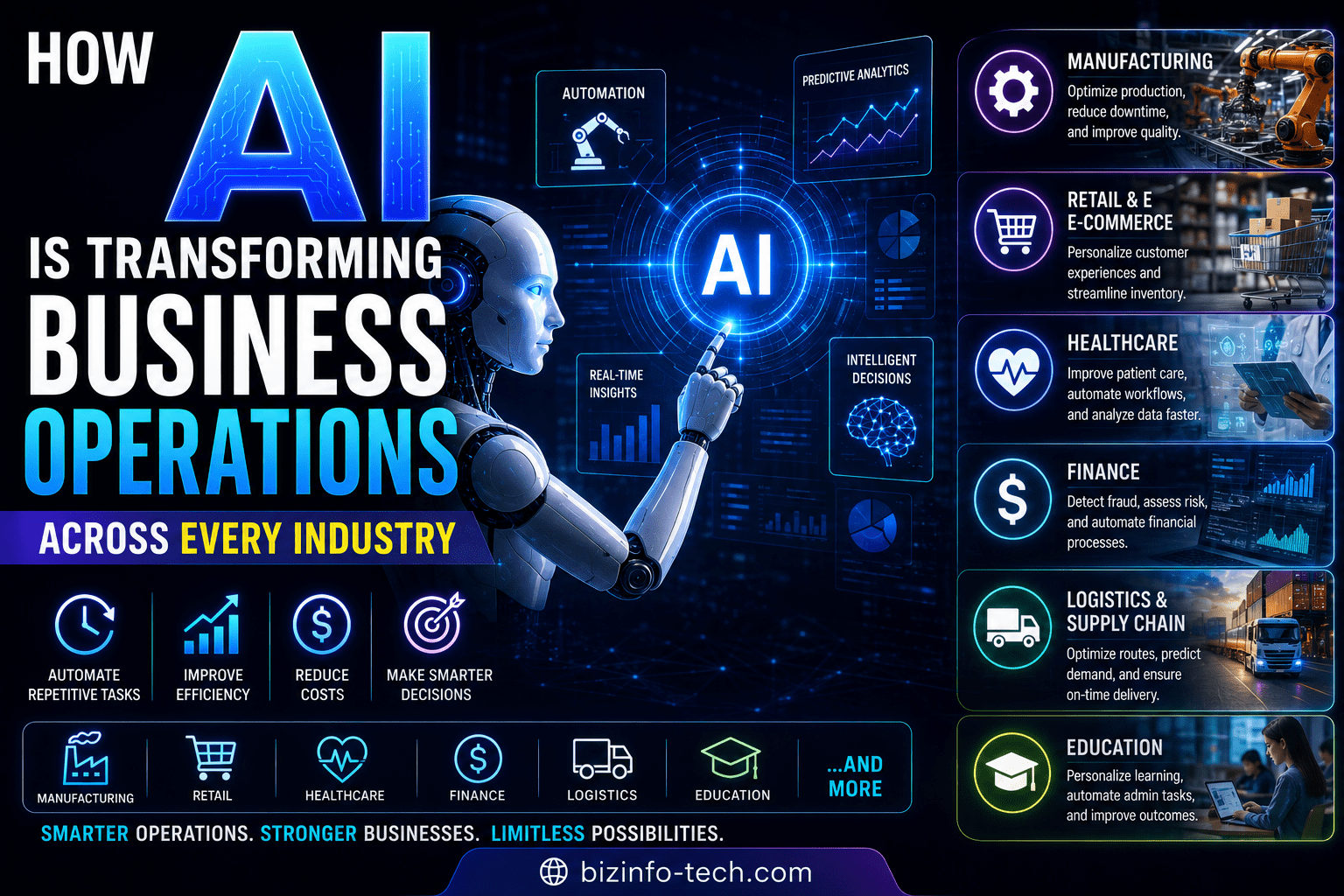
Walk into virtually any industry today — healthcare, manufacturing, financial services, retail, logistics, professional services, construction, education — and you’ll find AI actively changing how core operational work gets done. Not as a pilot program or a future roadmap item, but as live infrastructure that businesses depend on right now.
The transformation isn’t uniform. Different industries are at different stages. Some are early adopters who have been building AI into operations for years. Others are just beginning to grapple with what it means for their specific business model. But the direction is the same everywhere: AI is moving from the periphery of business operations to the center of it.
This matters for every business leader, operations manager, and entrepreneur — regardless of industry. Because the companies that understand how AI is reshaping their specific sector will make better decisions about where to invest, what to build, and how to compete. The ones that wait for the transformation to become impossible to ignore are already behind the ones who started two years ago.
This guide covers how AI is transforming operations across eight major industries, what the specific changes look like on the ground, and what the broader patterns mean for businesses of all sizes.
What’s Driving the Transformation Across Every Industry
Before the industry-by-industry breakdown, it’s worth understanding the underlying forces that are making this transformation so consistent and so fast across sectors that look completely different on the surface.
Data Has Become Universal
Every industry generates data now. Every transaction, interaction, production run, patient visit, customer complaint, logistics movement, and financial event creates data. For most of business history, that data was either impossible to collect or too expensive to analyze at scale. AI changes both of those constraints simultaneously.
The result is that industries that never thought of themselves as data-driven businesses are suddenly discovering that their operational data — if properly analyzed — contains insights that can fundamentally improve how they operate.
Labor Economics Are Shifting
In virtually every developed economy, the combination of rising labor costs, labor shortages in key roles, and increased competition has changed the math on what it costs to do operational work manually versus what it costs to automate it.
The tipping point — where automation is clearly the better economic choice for a wide range of tasks — has arrived in most industries. That economic reality is one of the primary drivers of AI adoption across sectors.
The Technology Has Matured Enough to Actually Work
Early AI applications in business had a significant implementation problem: they required large datasets, specialized expertise, and expensive custom development to build and maintain. That created a real barrier that kept AI accessible only to the largest, most technically sophisticated companies.
The tools available in 2026 are fundamentally different. Pre-trained models. No-code and low-code implementation options. AI features built directly into the business software most companies already use. The barrier to actually deploying AI in operations has dropped to the point where businesses of all sizes can access capabilities that were enterprise-only five years ago.
Healthcare: From Administrative Burden to Clinical Focus
Healthcare is one of the industries where the operational transformation driven by AI is most visibly significant — and where the stakes are highest.
The Problem AI Is Solving
Healthcare organizations face a paradox: they employ highly trained, expensive professionals to do enormous amounts of work that has nothing to do with patient care. Doctors spend more time documenting than examining. Nurses navigate complex administrative processes between clinical tasks. Billing departments manage Byzantine reimbursement workflows that require specialized expertise just to submit claims correctly.
The administrative burden in healthcare has been growing for decades. Studies consistently find that physicians spend more than half their working hours on administrative work rather than patient care. That’s not just an efficiency problem — it’s a quality problem. Burned-out clinicians make more mistakes. Overwhelmed staff miss things. Systems optimized for documentation over care produce worse outcomes.
What AI Is Changing
Clinical documentation is the most immediate and widespread application. AI tools that listen to doctor-patient conversations and automatically generate accurate clinical notes are being deployed at scale. Physicians describe finishing a patient visit and already having a draft note ready to review and sign — rather than spending 20 minutes after every appointment documenting.
Revenue cycle management — the complex process of billing, coding, and collecting payment from insurance companies — is being transformed by AI that can code diagnoses more accurately, identify claim errors before submission, and predict reimbursement issues. For a hospital running hundreds of thousands of claims, even small improvements in accuracy translate to millions of dollars recovered.
Diagnostic support is moving from research into clinical practice. AI systems trained on medical imaging data are being used to assist radiologists in identifying anomalies, reducing both error rates and the time required to review studies.
Patient flow management uses predictive AI to anticipate patient volume, staff accordingly, and reduce the bottlenecks — emergency department wait times, surgical suite utilization, bed management — that drive both patient dissatisfaction and cost.
The Net Effect
Healthcare organizations implementing AI operations are reporting meaningful reductions in administrative labor costs, improvements in billing accuracy, and — most importantly — clinicians who can focus more of their time on the work that required their training in the first place.
Manufacturing: The Smart Factory Becomes Standard
Manufacturing was one of the first industries to embrace automation, but the AI-driven transformation happening now is qualitatively different from what came before.
What’s New About AI in Manufacturing
Traditional factory automation replaced physical human labor with machines that performed specific, repetitive physical tasks. AI adds a layer of intelligence on top of that physical automation — and increasingly enables automation of the cognitive work involved in manufacturing: quality judgment, process optimization, maintenance prediction, supply chain coordination.
What AI Is Changing
Predictive maintenance has become one of the most economically significant AI applications in manufacturing. Rather than performing maintenance on a fixed schedule (expensive and often unnecessary) or waiting for equipment to fail (catastrophic and even more expensive), AI systems analyze sensor data from machines in real time and predict failures before they happen. The reduction in unplanned downtime this creates is measurable in millions of dollars for large manufacturers.
Quality control is being transformed by computer vision systems that can inspect products at machine speed with higher consistency and accuracy than human inspectors. Systems trained on thousands of images of defective products can identify subtle flaws that human eyes miss — particularly after hours of repetitive inspection when fatigue degrades human performance.
Production scheduling and optimization uses AI to navigate the complex trade-offs involved in allocating machines, materials, and labor across multiple product lines with varying demand, production rates, and constraints. What used to require skilled production planners spending hours working through scheduling scenarios manually can now be optimized automatically and updated in real time as conditions change.
Supply chain visibility has become a critical operational capability, particularly after the supply chain disruptions of recent years exposed the fragility of just-in-time manufacturing. AI systems that monitor supplier performance, logistics data, and demand signals — and flag risks before they become disruptions — are now viewed as essential operational infrastructure by most large manufacturers.
The Net Effect
Manufacturers who have integrated AI into their operations are reporting significant improvements in equipment uptime, reduction in defect rates, and better on-time delivery performance. The operational competitive advantage for early adopters is substantial — and it’s creating pressure on the rest of the industry to catch up.
Financial Services: Speed, Accuracy, and Compliance at Scale
Financial services is an industry defined by the need to process enormous volumes of transactions accurately, comply with complex regulations, manage risk precisely, and serve customers with increasingly high expectations for digital experiences. AI addresses all four of those imperatives simultaneously.
What AI Is Changing
Fraud detection was one of the earliest and most successful AI applications in financial services. Machine learning models that analyze transaction patterns in real time and flag anomalous activity are far more effective than rule-based systems — detecting more fraud while generating fewer false positives that create friction for legitimate customers.
Credit underwriting and risk assessment uses AI to analyze a broader range of data signals than traditional credit models — incorporating behavioral data, alternative data sources, and patterns that conventional credit scoring misses. The result is better risk prediction and, in many cases, credit access for customers who would have been declined by traditional models.
Regulatory compliance is one of the most expensive operational burdens in financial services. AI tools that can monitor transactions, communications, and activities for compliance issues — flagging potential violations for human review rather than requiring manual review of everything — are dramatically reducing both the cost and the error rate of compliance operations.
Customer service and operations are being transformed by AI tools that can handle routine inquiries, process standard transactions, and resolve common issues without human involvement — freeing human agents for complex, high-value interactions where judgment and empathy matter.
Back-office processing — the enormous volume of document processing, data verification, and reconciliation work that happens behind the scenes in financial institutions — is being automated using AI that can read, extract, and process information from documents with accuracy that approaches or exceeds human performance.
The Net Effect
Financial institutions that have invested in AI operations are reporting faster processing times, lower error rates, reduced compliance costs, and the ability to handle growing transaction volumes without proportional headcount growth. The efficiency gap between AI-enabled and traditionally operated financial firms is widening every year.
Retail and E-Commerce: Personalization and Efficiency at Scale
Retail has been transformed by e-commerce, and AI is now transforming both the economics and the customer experience of retail at every scale.
What AI Is Changing
Demand forecasting and inventory management is perhaps the highest-impact AI application in retail operations. The cost of getting inventory wrong — either stockouts that lose sales or overstock that requires markdowns — is enormous. AI systems that analyze sales history, seasonal patterns, promotional calendars, external signals like weather and local events, and competitive pricing can forecast demand with significantly higher accuracy than statistical models, reducing both stockouts and overstock simultaneously.
Personalization at scale — delivering individually relevant product recommendations, offers, and communications to millions of customers — is now a foundational e-commerce capability that AI makes possible. The revenue impact of well-implemented personalization is consistently significant: customers who see relevant recommendations spend more, return more often, and churn at lower rates.
Dynamic pricing uses AI to adjust prices in real time based on demand, competition, inventory levels, and customer segments. This is standard practice in e-commerce and increasingly common in physical retail as well.
Supply chain and logistics optimization — routing delivery vehicles efficiently, optimizing warehouse operations, coordinating supplier shipments — uses AI to improve speed and reduce cost simultaneously.
Customer service automation handles the enormous volume of routine customer inquiries — order status, return initiation, basic product questions — that would otherwise require large customer service teams.
The Net Effect
Retailers using AI operations report higher inventory accuracy, improved sell-through rates, better customer retention, and the ability to compete on personalization with larger competitors who have more data and more resources.
Professional Services: Doing Better Work in Less Time
Law firms, accounting firms, consulting firms, marketing agencies, and other professional services businesses all share a common operational model: they sell expertise, delivered through human time. AI is changing the economics of that model fundamentally.
What AI Is Changing
Research and analysis — which in professional services can consume enormous amounts of billed and unbilled time — is being transformed by AI tools that can search, synthesize, and summarize large volumes of information faster than any human researcher. A legal team that previously spent three days reviewing documents for a due diligence matter can now do it in a day. A consulting team that needed a week to develop a market analysis can now develop a better one in two days.
Document generation and review — contracts, reports, proposals, audit workpapers, deliverables — involves significant repetitive work even in highly skilled professions. AI tools that can generate first drafts from structured inputs, review documents against defined criteria, and flag issues for human review are creating meaningful efficiency gains without compromising the quality of expert judgment applied to the final work.
Client communication — keeping clients informed, managing expectations, handling routine questions — generates a volume of communication work that AI can substantially assist with. First drafts of client updates, automated status communications, AI-assisted responses to routine inquiries.
Business development — identifying prospects, researching potential clients, drafting outreach, managing follow-up — is an area where AI assistance can significantly increase the effectiveness of business development efforts without requiring proportional increases in senior partner time.
The Net Effect
Professional services firms that have embraced AI are delivering higher-quality work faster, handling more client engagements without proportional headcount growth, and finding that junior staff are contributing at a higher level because AI is accelerating their research and analysis capabilities.
Logistics and Supply Chain: Visibility and Optimization
Logistics is an operationally intensive industry where margins are thin, complexity is high, and the ability to move goods reliably and efficiently is the core competitive differentiator. AI is transforming every layer of it.
What AI Is Changing
Route optimization has been AI-assisted for years, but the sophistication of current systems — accounting for real-time traffic, weather, vehicle capacity, delivery time windows, driver hours regulations, and fuel costs simultaneously — is dramatically higher than what was possible even five years ago. The efficiency gains compound quickly at scale.
Warehouse operations use AI-powered robotics and optimization software to handle the complex coordination of receiving, storage, picking, packing, and shipping that happens in modern fulfillment centers. The speed and accuracy improvements are significant.
Demand sensing and supply chain planning uses AI to analyze market signals and adjust supply chain operations proactively — ordering more inventory before demand spikes, rerouting shipments around disruptions, adjusting production schedules based on updated forecasts.
Carrier management and freight procurement use AI to analyze shipping options across hundreds of carriers, compare rates and service levels, and make routing decisions that optimize for cost and reliability simultaneously.
Last-mile delivery optimization — the most expensive part of the logistics chain — uses AI to optimize delivery density, reduce failed delivery attempts, and improve the customer experience around delivery scheduling and communication.
The Net Effect
Logistics companies and supply chain operations using AI report meaningful reductions in transportation costs, improvement in on-time delivery rates, and better resilience when disruptions occur — because AI systems can identify problems and model alternative approaches faster than human planners.
Construction and Real Estate: An Industry Mid-Transformation
Construction is an industry that has historically been slow to adopt technology — and it’s paying for that lag with persistent productivity problems. AI is now creating pressure for change that’s harder to resist.
What AI Is Changing
Project planning and scheduling uses AI to model complex project dependencies, resource constraints, and risk factors — producing schedules that are more realistic and more responsive to changes than manually developed plans.
Cost estimation is being improved by AI tools that can analyze historical project data, current material costs, and local labor market conditions to produce more accurate cost estimates — reducing both the underbidding that kills project profitability and the overbidding that loses work.
Site safety monitoring uses computer vision to monitor construction sites for safety violations — workers not wearing required protective equipment, unsafe equipment positioning, hazardous conditions — and flag issues in real time.
Document and contract management — the enormous volume of drawings, specifications, change orders, RFIs, and contracts involved in construction projects — is being organized and made searchable by AI tools that can surface relevant information when disputes arise or decisions need to be made.
Property management in real estate uses AI for predictive maintenance, tenant communication automation, lease management, and market analysis that informs investment and pricing decisions.
The Net Effect
Construction and real estate organizations adopting AI operations are reporting improvements in project delivery timelines, cost accuracy, and safety performance — while reducing the administrative burden that has always been a drain on productive site work.
The Cross-Industry Patterns That Matter
Looking across all of these industries, certain patterns emerge that are worth understanding regardless of which sector you’re in.
The First-Mover Advantage Is Real and Compounding
In every industry where AI adoption has been underway for several years, the gap between early adopters and laggards is widening, not narrowing. This is because operational AI creates compounding advantages: the data generated by AI systems improves their performance over time, and the operational efficiencies created free up resources to invest in further improvements.
The companies waiting to see how AI shakes out in their industry are watching competitors build advantages that will be increasingly expensive to close.
The Transformation Is Operational Before It’s Strategic
In most industries, AI is transforming operations before it transforms strategy or business models. The first wave of AI impact is almost always about making existing processes faster, cheaper, and more accurate — not about reinventing what the business does.
This matters for how you approach it. You don’t need a grand AI strategy to start capturing value. You need to identify the operational work in your business that is most expensive, most error-prone, or most time-consuming — and start there.
The Human Role Is Shifting, Not Disappearing
Across every industry, the most effective AI implementations are the ones that elevate human work rather than simply replacing it. AI handles the high-volume, rule-based, data-intensive work. Humans focus on judgment, relationships, creativity, and the complex situations that automated systems aren’t equipped to handle.
The professional services partner who can serve twice as many clients because AI is handling research and document work. The operations manager who can oversee more complex operations because AI is monitoring routine performance. The healthcare provider who can spend more time with patients because AI is handling documentation.
The shift is real — some roles will change significantly, and some will diminish. But the direction for most knowledge workers is toward higher-value work, not unemployment.
Small Businesses Can Access What Used to Be Enterprise-Only
Five years ago, most of the AI capabilities described in this article were accessible only to large enterprises with significant technical budgets. The democratization of AI tools has changed that substantially.
A small accounting firm can now use document processing AI that works like what the Big Four use. A small manufacturer can deploy predictive maintenance tools that work like what the large industrial companies built custom. A small retailer can access demand forecasting and personalization capabilities that were previously beyond reach.
The playing field isn’t entirely level — larger organizations still have data and resource advantages. But the gap has closed dramatically, and it continues to close.
What This Means for Your Business
Whether you’re running a small business, managing operations for a mid-sized company, or leading a division of a larger organization, the cross-industry transformation happening right now has direct implications for you.
Your competitors are doing this. Regardless of your industry, there are businesses in your market that have been investing in operational AI for two or three years. They are operating more efficiently, serving customers faster, making better decisions, and building advantages that compound over time.
The entry point is lower than you think. The tools available today — particularly through accessible platforms like Zapier, Make, and the AI-integrated business software most companies already use — make meaningful operational improvement accessible without large capital investment or specialized technical expertise.
The best place to start is your biggest current bottleneck. Not an industry-wide transformation initiative. Not a comprehensive AI strategy. The single operational process that is consuming the most time, creating the most errors, or causing the most friction in your business right now. Start there. Build one good solution. Measure the impact. Then build the next one.
The window for differentiation is still open. In most industries, AI adoption is advanced enough that ignoring it is a real competitive risk — but early enough that moving decisively now still creates meaningful advantage. That window will close. The businesses that move in the next 12–18 months will be far better positioned than those that wait another two or three years.
Frequently Asked Questions
Is AI transforming small businesses the same way it’s transforming large enterprises?
The tools and applications are similar, but the scale and starting point are different. Large enterprises are often working to modernize legacy systems and coordinate AI adoption across hundreds of processes simultaneously. Small businesses can move faster and more nimbly — adopting specific tools to solve specific problems without the organizational complexity that slows large-scale implementation.
Which industry is furthest ahead in AI operations adoption?
Financial services and technology companies have generally been the earliest and deepest adopters. Healthcare, retail, and logistics are mid-transformation. Manufacturing is accelerating rapidly. Construction and some professional services categories are in earlier stages.
Will AI eliminate jobs in my industry?
AI will change the nature of work in virtually every industry — some tasks that humans currently perform will be automated, and new tasks will emerge. The most consistent pattern is that AI is transforming roles rather than eliminating industries. The jobs at highest risk are those defined primarily by high-volume, routine, predictable tasks. Jobs that require judgment, creativity, relationships, and complex problem-solving are evolving rather than disappearing.
How do I know which AI applications are most relevant for my specific industry?
Look at what the most operationally sophisticated competitors in your industry are doing. Look at where your highest operational costs are and where errors or delays cause the most problems. The intersection of “high cost or friction” and “well-established AI solution available” is where to start.
Is the ROI from AI operations actually proven, or is it mostly hype?
The ROI is real and measurable in the industries and applications where adoption is most mature. Fraud detection in financial services, predictive maintenance in manufacturing, demand forecasting in retail, clinical documentation in healthcare — these are applications with years of deployment data and well-documented economic outcomes. The hype exists around more speculative applications, but the core operational AI use cases have solid evidence behind them.
Final Thought
The transformation of business operations by AI is not a future event. It is a current reality playing out, at different speeds, across every industry.
The businesses navigating it best share a common approach: they start with specific operational problems rather than general AI enthusiasm. They build incrementally, measuring impact at each step. They treat AI as an operational layer that makes their people more effective — not a replacement for the human judgment, creativity, and relationships that define great businesses.
That approach is available to any business willing to take it. The tools exist. The ROI is proven. The competitive pressure is real and growing.
The question isn’t whether AI will transform your industry’s operations. It already is.
The question is whether your business will be among the ones leading that transformation — or among the ones trying to catch up to it.
Related reads: The Ultimate Guide to AI for Business Operations | AI Systems for Entrepreneurs: How to Run More Efficiently with Less Effort | AI Automation vs Human Labor: Where Businesses Should Draw the Line