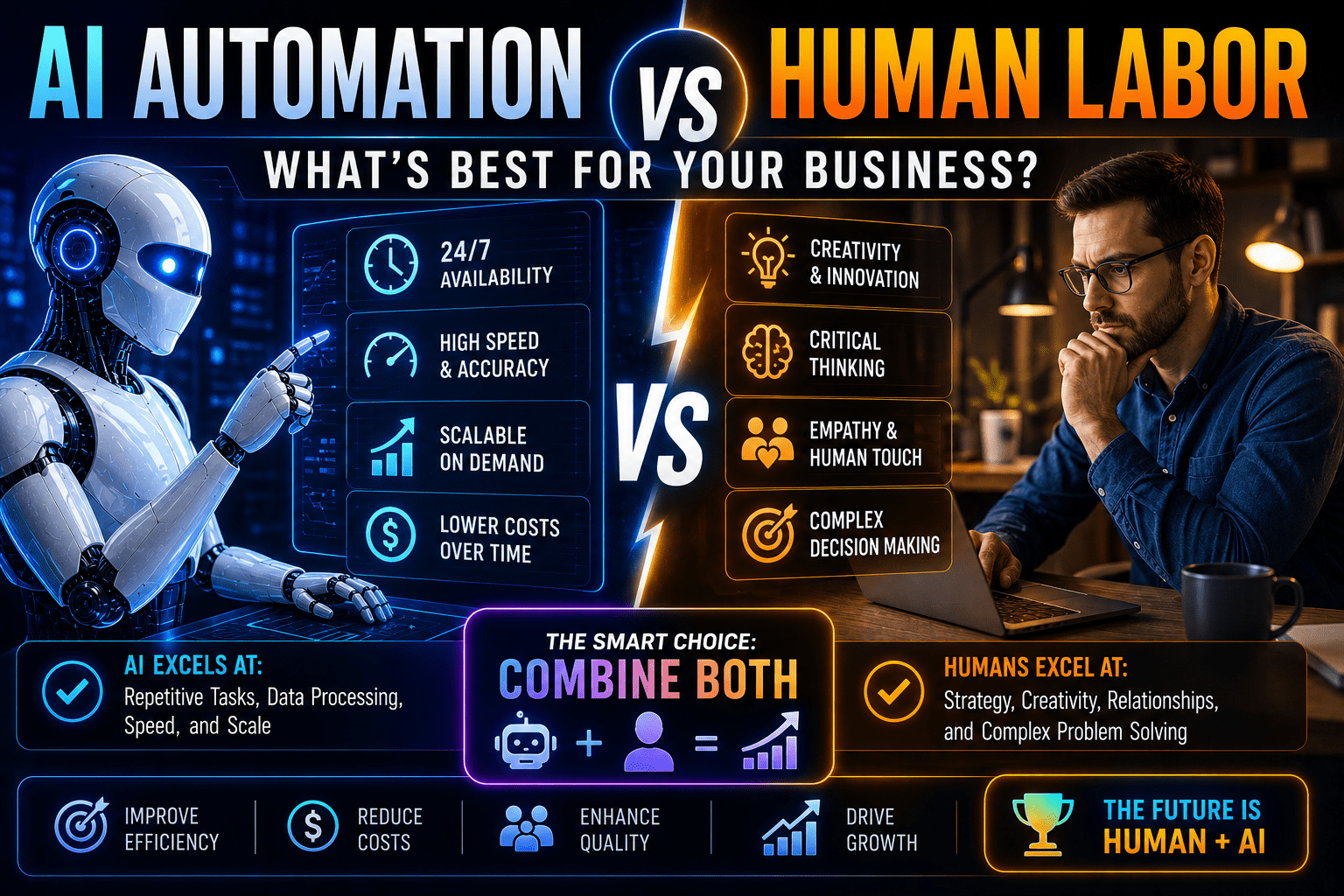
The Question Every Business Eventually Has to Answer
At some point in every business’s AI adoption journey, a harder question emerges beneath all the practical ones about tools and workflows.
It’s not “which AI tool should we use?” It’s “how much of this should actually be automated — and where do we stop?”
This question matters more than it might first appear. Get it wrong in one direction, and you under-invest in automation, leaving your team buried in repetitive work while competitors who’ve automated more aggressively pull ahead. Get it wrong in the other direction, and you over-automate — degrading the quality of customer relationships, losing the judgment and creativity that actually differentiate your business, and potentially damaging trust with both customers and employees.
This isn’t a question with a universal answer. The right line is different for every business, every function, and often every specific task. But it is a question that has a clear, principled way to think it through — and that’s what this guide provides.
Whether you’re an operations manager trying to decide what to automate next, a business owner setting policy for your team’s AI adoption, or an entrepreneur figuring out where AI fits into your one-person operation, this guide will give you a practical framework for making that call well.
Why This Question Is Harder Than It Looks
It’s tempting to reduce this to a simple heuristic: automate the boring stuff, keep humans on the important stuff. That’s not wrong exactly, but it’s not precise enough to be genuinely useful — because “boring” and “important” aren’t the actual variables that determine whether a task should be automated.
Plenty of important work is also highly automatable. Financial reconciliation is critically important and also extremely well-suited to automation. Plenty of seemingly mundane work actually requires meaningful human judgment. A “simple” customer complaint can require real emotional intelligence to handle well.
The actual variables that should drive the automate-or-keep-human decision are more specific than “boring vs. important.” Let’s get into what they actually are.
The Four-Factor Framework for Drawing the Line
After analyzing how the most operationally sophisticated businesses make this decision, four factors consistently determine where the line should be drawn. Evaluate any task or process against these four factors, and the right answer tends to become clear.
Factor 1: Does It Require Genuine Judgment or Pattern Recognition?
There’s a meaningful difference between tasks that require judgment and tasks that merely feel like they do because they’re unfamiliar or because a human has always done them.
Pattern recognition tasks — even complex ones — are usually strong automation candidates. Categorizing a support ticket by urgency and topic. Scoring a lead based on defined criteria. Routing an approval request based on dollar amount and department. These feel like they require judgment, but they’re actually pattern matching against criteria that can be defined clearly. AI is exceptionally good at this.
Genuine judgment tasks involve weighing considerations that don’t reduce to a checklist — competing values, ambiguous information, stakes that depend heavily on context, or decisions that require taking responsibility for an outcome in a way that matters to the people involved. Deciding whether to fire an underperforming employee. Determining how to handle a major client relationship crisis. Making a strategic pivot in response to market changes. These require human judgment — not because AI can’t process the information, but because the decision carries weight that depends on accountability, context, and values that go beyond pattern matching.
The test: Ask whether the “right answer” to this task could, in principle, be derived from a clear set of criteria applied consistently. If yes, it’s a pattern recognition task — strong automation candidate. If the right answer depends on weighing genuinely competing considerations in a way that reasonable people might resolve differently based on values and context, it’s a judgment task — keep it human, possibly with AI support.
Factor 2: What’s the Cost of Being Wrong?
Not every mistake is equal. Some errors are trivial — easily caught and corrected. Others are serious — expensive, damaging to relationships, or difficult to reverse.
The cost of being wrong should directly inform how much human oversight a process needs, even when automation handles the execution.
Low cost of error: A social media post that’s slightly off-brand can be edited or deleted. An internal report with a minor formatting issue is easily fixed. These processes can run with high autonomy and lighter human review.
Moderate cost of error: A client communication with an awkward tone might cause some friction but is usually recoverable with a follow-up. A misrouted support ticket adds delay but rarely causes lasting damage. These processes benefit from automation but typically need a human review step for anything outside routine patterns.
High cost of error: A legal contract with an incorrect term. A medical or financial recommendation that’s wrong. A major client communication that damages a key relationship. A public-facing statement that misrepresents the company. These need human review and approval before execution, even if AI assists in preparing the work — because the cost of getting it wrong is high enough that the efficiency gained from full automation isn’t worth the risk.
The test: If this process produces a wrong output, how bad is it, and how hard is it to fix? The higher the cost and the harder the reversal, the more human oversight the process needs — even if AI is doing most of the actual work.
Factor 3: Does the Human Element Itself Create Value?
Some tasks are valuable specifically because a human is doing them — not just because of the output produced, but because of what the human involvement signals or provides.
The relationship premium: A handwritten thank-you note carries different meaning than an automated one, even if the words are identical. A founder personally calling a major client to address a problem signals something an automated apology email cannot. A manager who personally delivers difficult feedback, rather than routing it through an automated performance review system, demonstrates respect that the content alone doesn’t convey.
This isn’t about the task being inherently un-automatable. It’s about the human involvement itself being part of the value delivered.
Where this matters most: High-stakes client relationships, sensitive personnel matters, situations where trust is being built or repaired, moments that customers or employees will remember and weigh heavily in how they feel about your business.
Where this matters less: Routine transactional communications, internal process updates, standard confirmations, situations where speed and consistency matter more to the recipient than the source.
The test: Would the person on the receiving end of this interaction feel differently — and would that difference matter to the relationship — if they knew a human versus an AI was responsible? If yes, weight toward keeping it human, or at minimum keeping a human visibly involved.
Factor 4: What’s the Volume and Repetition Level?
This is the most straightforward factor, but it’s still worth being explicit about. The economic and quality case for automation strengthens dramatically as volume and repetition increase.
A task performed once a year, even if it’s relatively mechanical, often isn’t worth the investment of building reliable automation around. The setup time exceeds the time saved.
A task performed dozens or hundreds of times a week — even one with moderate complexity — usually justifies automation investment many times over, because the time savings compound rapidly and the consistency improvement (humans get tired, distracted, and inconsistent at high volume in ways that automated systems don’t) becomes increasingly valuable.
The test: Multiply the time per occurrence by the frequency. If the resulting weekly or monthly time investment is significant, automation is likely worth pursuing — assuming Factors 1–3 don’t argue against it.
Putting the Framework Together: A Decision Matrix
Here’s how to use all four factors together when evaluating a specific task or process.
Strong automation candidates score as: pattern-based (not judgment-based), low-to-moderate cost of error, low relationship premium, high volume/repetition.
Examples: Data entry, scheduling, routine report generation, lead scoring, invoice generation, ticket routing, follow-up reminders, standard email responses to common inquiries.
AI-assisted, human-reviewed candidates score as: some judgment involved, moderate-to-high cost of error, moderate relationship premium, moderate-to-high volume.
Examples: Client proposal drafting (AI drafts, human reviews and personalizes), performance report analysis (AI surfaces insights, human interprets and decides action), content creation (AI drafts, human edits for voice and accuracy), sales outreach (AI assists with research and drafting, human sends and personalizes).
Keep-human candidates score as: genuine judgment required, high cost of error, high relationship premium, regardless of volume.
Examples: Termination decisions, major client relationship management, strategic planning, sensitive negotiations, crisis communication, final approval on high-stakes legal or financial commitments.
This isn’t a rigid formula that produces a single correct answer for every situation. It’s a structured way of thinking that surfaces the right considerations — and most business leaders find that once they walk through these four factors explicitly, the right call becomes much clearer than it felt before they had the framework.
Where Businesses Commonly Get This Wrong
Understanding the framework is one thing. Applying it well in practice is another. Here are the most common mistakes businesses make on both sides of the line.
Mistake 1: Over-Automating Customer-Facing Judgment Calls
A frequent pattern: a business automates customer support responses so aggressively that customers with genuinely complex or emotionally charged issues get routed through a chatbot flow that clearly wasn’t built for their situation. The customer feels unheard, frustrated, and undervalued — and the cost to the relationship far outweighs the support hours saved.
The fix isn’t avoiding AI in customer support. It’s building clear escalation paths — AI handles the routine 70-80% of inquiries excellently, and anything that doesn’t clearly fit a known pattern (or anything where the customer signals frustration) routes immediately to a human.
Mistake 2: Under-Automating High-Volume Pattern Work Out of Caution
The opposite mistake: businesses that are appropriately cautious about high-stakes decisions extend that caution unnecessarily to high-volume, low-stakes pattern work. A finance team that’s rightly careful about major financial decisions might also insist on manually reviewing every routine expense report — a task that’s genuinely well-suited to automated policy-based approval.
The fix is applying the four-factor framework specifically rather than generally. Caution about strategic decisions shouldn’t bleed into unnecessary caution about routine, low-stakes, high-volume work.
Mistake 3: Treating “Human Touch” as Binary
Many businesses think about this as an all-or-nothing choice — either a human does the whole thing, or AI does the whole thing. The most effective approach is almost always hybrid: AI handles the mechanical and preparatory work, and humans apply judgment and relationship investment at the specific points where it matters most.
A salesperson doesn’t need to personally research every prospect from scratch — AI can prepare detailed briefings. But the salesperson should personally make the call and build the relationship. A manager doesn’t need to manually compile performance data — AI can surface the trends — but the manager should personally deliver feedback conversations.
Mistake 4: Not Revisiting the Line as AI Capabilities Improve
The right line between automation and human labor is not fixed. AI capabilities have improved substantially over the past several years, and tasks that genuinely required human judgment three years ago may now be handled well by AI — particularly with appropriate guardrails and oversight.
Businesses that set their automation policy once and never revisit it miss ongoing opportunities to capture additional efficiency as the technology matures. A quarterly or biannual review of where the line currently sits — informed by actual experience with how AI tools are performing — keeps the policy current rather than stuck in an outdated assessment.
Mistake 5: Ignoring Employee Sentiment in the Calculation
The decision about where to draw the automation line isn’t purely a technical or economic question — it’s also an organizational one. Employees who feel that automation decisions are being made without consideration for their roles, expertise, or wellbeing will resist adoption even when the underlying logic is sound.
Involving the people who currently do a task in evaluating whether and how it should be automated produces better decisions (because they understand the nuances of the work better than anyone) and better adoption (because they’re part of the process rather than subjects of it).
A Function-by-Function Look at Where the Line Typically Falls
To make this more concrete, here’s how the four-factor framework typically plays out across common business functions.
Customer Service
Strong automation: FAQ responses, order status inquiries, basic troubleshooting, appointment scheduling, return initiation.
AI-assisted, human-reviewed: Complex technical support (AI surfaces likely solutions, human verifies and personalizes), proactive outreach to at-risk accounts (AI flags the risk, human makes the call).
Keep human: Complaint resolution involving genuine dissatisfaction, situations with emotional intensity, high-value account relationship management, any interaction where the customer has explicitly asked for a human.
Sales
Strong automation: Lead capture and initial qualification, CRM data entry, follow-up reminder sequences, meeting scheduling, basic proposal generation from templates.
AI-assisted, human-reviewed: Lead research and account briefings (AI compiles, human reviews before the call), personalized outreach drafting (AI drafts, human personalizes and sends), proposal customization for complex deals.
Keep human: Actual sales conversations and relationship building, complex negotiation, strategic account planning for major clients.
Marketing
Strong automation: Social media scheduling, basic content repurposing, campaign performance reporting, A/B testing analysis, email send-time optimization.
AI-assisted, human-reviewed: Content drafting (AI drafts, human edits for brand voice and accuracy), ad copy variations (AI generates options, human selects and refines), campaign strategy recommendations (AI surfaces data-driven suggestions, human decides direction).
Keep human: Brand strategy and positioning decisions, crisis communication, creative direction for major campaigns, decisions involving sensitive cultural or social topics.
Finance
Strong automation: Invoice generation, expense categorization, routine reconciliation, standard financial reporting, payment reminders.
AI-assisted, human-reviewed: Financial forecasting (AI generates projections, human applies business context), budget variance analysis (AI flags anomalies, human investigates and decides action), vendor contract review (AI flags unusual terms, human evaluates).
Keep human: Major financial decisions and capital allocation, final approval on significant expenditures, audit judgment calls, decisions involving legal or regulatory risk.
HR and People Operations
Strong automation: Scheduling interviews, sending onboarding paperwork, basic policy Q&A, PTO request processing against defined policy.
AI-assisted, human-reviewed: Resume screening (AI surfaces candidates matching criteria, human makes final judgment), performance data compilation (AI aggregates, human interprets and delivers feedback), employee sentiment analysis (AI flags trends, human investigates).
Keep human: Hiring decisions, termination decisions, compensation decisions, performance feedback conversations, conflict resolution, any situation involving an employee’s wellbeing or career trajectory.
The Trust Dimension: Building Confidence Before Expanding Automation
One pattern worth understanding explicitly: the right line for your business today is not necessarily the right line in twelve months. As your AI systems demonstrate reliability, the appropriate scope of automation typically expands.
This isn’t about blind faith in the technology getting better — it’s about earning trust through demonstrated performance in your specific context.
A Practical Trust-Building Sequence
Stage 1: AI assists, human executes. AI prepares drafts, research, summaries, or recommendations. A human reviews everything before it goes out or gets acted on. This stage builds confidence in the quality of AI output without any risk of unreviewed mistakes reaching customers or affecting decisions.
Stage 2: AI executes routine cases, human handles exceptions. Once you’ve observed AI performance over enough volume to trust its judgment on clearly-defined, routine scenarios, let it execute those autonomously while routing anything outside the defined patterns to a human.
Stage 3: AI executes broadly with monitoring and spot-checks. As confidence grows further, expand AI’s autonomous scope, while maintaining ongoing quality monitoring — periodic review of outputs, tracking of error rates, and clear escalation paths for anything that goes wrong.
Stage 4: AI executes independently within defined guardrails. For the highest-confidence, lowest-stakes processes, AI runs fully autonomously within clearly defined parameters, with human involvement limited to periodic system review rather than individual case oversight.
Most processes should move through these stages deliberately rather than jumping straight to full automation. The time invested in Stages 1 and 2 is what makes Stages 3 and 4 trustworthy rather than reckless.
What This Means for Your Team
Drawing this line well has implications beyond the immediate task being evaluated — it shapes how your team experiences the shift toward AI-powered operations.
Frame Automation as Elevation, Not Replacement
When team members understand that automation is targeting the repetitive, pattern-based work specifically so they can focus on the judgment-based, relationship-based, high-value work — rather than experiencing automation as a vague threat to their role — adoption and morale improve significantly.
This framing needs to be genuine, not just rhetorical. If your automation strategy is actually aimed at reducing headcount rather than elevating the work of your existing team, be honest about that internally rather than using “elevation” language that doesn’t match reality. Trust, once damaged by a mismatch between stated intent and actual outcome, is very hard to rebuild.
Give Your Team a Voice in Where the Line Sits
The people doing the work every day have insight into the four factors that you, as a manager or owner, may not fully see. They know which “routine” tasks actually require more judgment than they appear to from the outside. They know which automated processes are creating friction with customers. Building a regular feedback loop — where the team can flag automation that’s not working well, or suggest automation opportunities you haven’t considered — produces better decisions and better buy-in.
Be Transparent With Customers About What’s Automated
As automation expands, particularly in customer-facing functions, transparency matters. Customers generally don’t mind interacting with well-designed automated systems — fast, accurate responses to routine questions are often preferred to waiting for a human. What damages trust is automation that pretends to be human, or that handles something poorly that a customer reasonably expected a human to handle with judgment.
Clear signals — “I’m an AI assistant, here’s how I can help, and here’s how to reach a human if you need to” — tend to perform better than automation that tries to pass as human and falls short when the interaction gets complex.
Frequently Asked Questions
Is there an industry standard for what percentage of work should be automated?
No, and treating this as a percentage-based target misses the point of the framework. The right answer depends entirely on the specific tasks, their risk profile, and their relationship value — not on hitting some industry benchmark. Focus on applying the four-factor framework to your specific processes rather than aiming for an arbitrary automation percentage.
How do I know if I’ve automated too much?
Watch for these signals: declining customer satisfaction scores, increasing escalations or complaints about feeling unheard, employee feedback that the automated systems are creating more problems than they solve, and situations where customers explicitly express frustration at not being able to reach a human. Any of these suggest revisiting where you’ve drawn the line.
How do I know if I’m not automating enough?
Watch for these signals: your team consistently working overtime on tasks that feel mechanical and repetitive, response times that are consistently slower than customer expectations or competitor benchmarks, high error rates on routine tasks due to human fatigue or inconsistency, and operational costs that are clearly higher than what automated alternatives would cost.
Should the line be different for a small business versus a large enterprise?
The framework is the same, but the specific calculus often differs. Small businesses frequently have less capacity to absorb high-volume manual work, which can push more tasks toward automation even at moderate volume. Large enterprises often have more resources to dedicate to manual oversight of complex tasks, but also face higher stakes and reputational risk from automation failures at scale, which can argue for more conservative automation in customer-facing and high-stakes functions.
What if my team disagrees with where I want to draw the line?
This disagreement is valuable information, not an obstacle to override. If your team consistently pushes back on a proposed automation, dig into why — they may be seeing risk or nuance you’re missing. If after genuine discussion you still believe the automation is right, explain your reasoning clearly and consider a pilot period with built-in review points rather than an irreversible full rollout.
Final Thought
The question of where to draw the line between AI automation and human labor doesn’t have a single right answer that applies to every business, every function, or every moment in time. But it does have a right way to think about it.
Evaluate the genuine judgment required. Weigh the cost of being wrong. Consider whether human involvement itself creates value. Account for volume and repetition.
Apply that framework deliberately, function by function, task by task — rather than defaulting to blanket policies in either direction. Build trust in your AI systems incrementally rather than jumping straight to full autonomy. And keep revisiting the line as both your experience and the underlying technology evolve.
The businesses that get this right aren’t the ones that automate the most or the ones that automate the least. They’re the ones that draw the line thoughtfully — creating operations that are both genuinely efficient and genuinely good to interact with, for customers and employees alike.
That’s the actual goal. Everything in this framework is in service of getting there.
Related reads: The Ultimate Guide to AI for Business Operations | The Hidden Cost of Manual Business Processes (And How AI Solves It) | AI Automation vs Traditional Automation: Which Is Better for Modern Businesses?