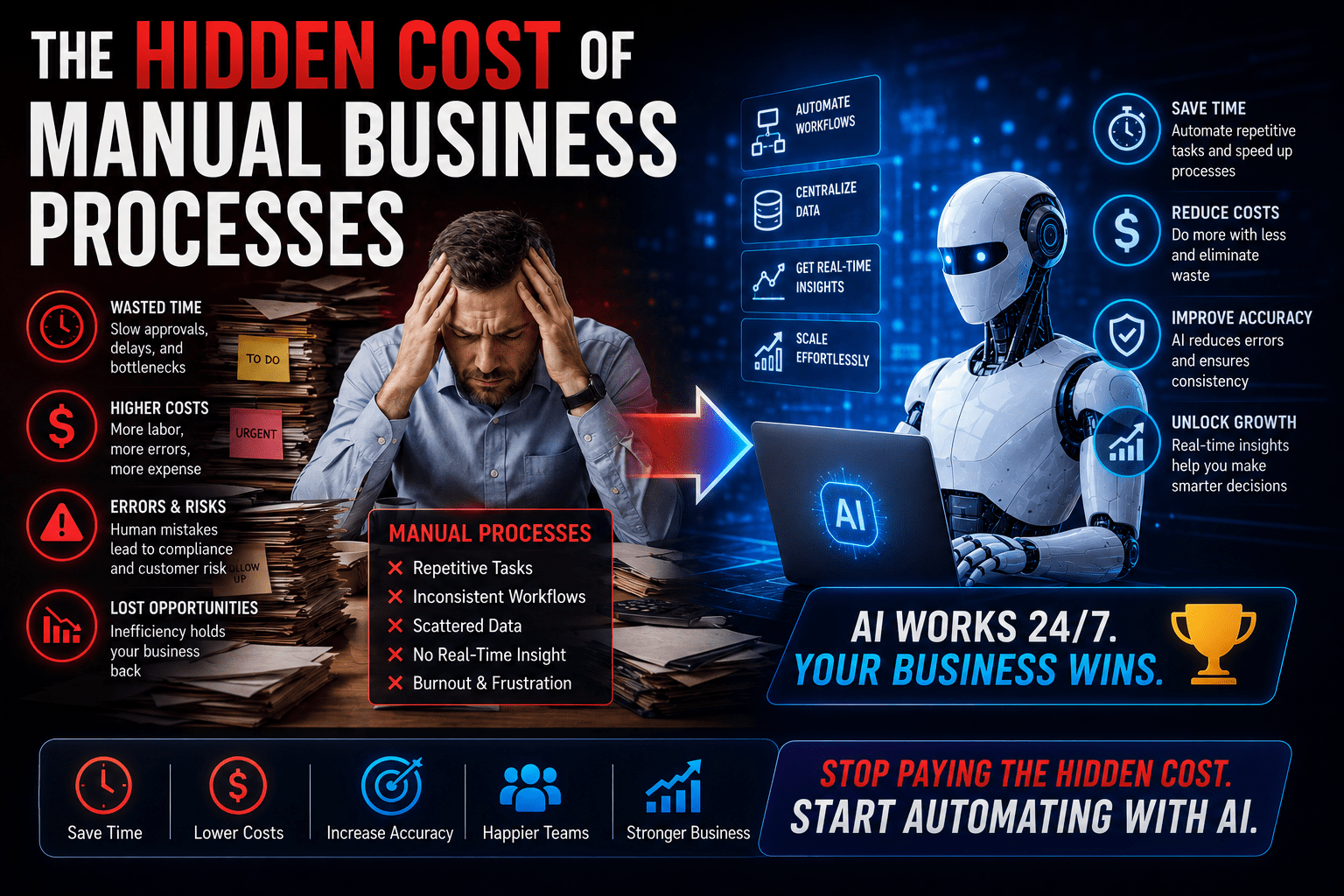
The Cost You Can’t See on Any Spreadsheet
Every business has a line item for labor costs. Salaries, benefits, contractor fees — it’s all there in black and white, easy to find, easy to track.
What doesn’t show up anywhere on that spreadsheet is the cost of how that labor is being spent. The hours your highly capable, well-compensated team members spend on work that has nothing to do with why you hired them. The opportunities lost because someone was too buried in administrative tasks to notice them. The mistakes that happened not because anyone was incompetent, but because manual processes are inherently more error-prone than systematic ones. The growth that didn’t happen because your operations couldn’t scale without proportionally scaling headcount.
This is the hidden cost of manual business processes. It’s real. It’s significant. And because it doesn’t appear as a clean number on any financial statement, most businesses dramatically underestimate it.
This guide is about making that hidden cost visible — quantifying it in terms you can actually use to make decisions — and then walking through exactly how AI addresses each dimension of it.
By the end, you’ll have a clear-eyed view of what manual processes are actually costing your business, and a practical understanding of how much of that cost is recoverable.
The Five Hidden Costs of Manual Processes
Manual processes don’t just cost time. They cost in five distinct ways, and most businesses only think clearly about the first one.
Hidden Cost 1: Direct Labor Time
This is the cost most people think of first, and it’s real — but it’s also the most visible and most frequently underestimated cost of the five.
Consider a task that takes 10 minutes and happens 15 times a week. That’s 150 minutes — two and a half hours weekly, or roughly 130 hours annually. At a fully loaded labor cost of even a modest $35 per hour, that single repetitive task is costing the business over $4,500 per year.
Most businesses have dozens of tasks in this category. When you add them up — and most businesses never do this exercise — the total is consistently larger than expected. It’s common for a business to discover that 20–40% of its total labor cost is going toward work that’s largely or entirely automatable.
Why this is underestimated: Individual tasks feel small in isolation. Ten minutes here, fifteen minutes there. The compounding effect across a week, a month, a year, and across an entire team only becomes visible when you actually do the math — which most businesses never sit down to do.
Hidden Cost 2: Error and Rework Cost
Manual processes are inherently more error-prone than systematic, automated ones. Humans get tired. They get distracted. They have bad days. They forget steps. They transpose numbers. They send the wrong attachment. They reply to the wrong thread.
Each of these errors has a cost — not just the time to fix the immediate mistake, but the downstream consequences. A data entry error in a CRM propagates into bad reporting, which propagates into bad decisions. A missed follow-up costs a deal. A billing error damages a client relationship and delays payment.
The real cost of errors is rarely just the fix. It’s the trust damaged, the time spent diagnosing what went wrong, the secondary errors that cascade from the first one, and the opportunity cost of the time spent on rework instead of new work.
Industry research on manual data entry errors consistently finds error rates in the range of 1-4% for routine manual processes — meaning roughly 1 in every 25-100 manual actions contains a mistake. At any meaningful volume, this is a substantial and continuous cost.
Why this is underestimated: Errors are usually addressed individually, in the moment, without anyone tracking the cumulative pattern. A business rarely steps back and asks: how many errors happened this month across all our manual processes, and what did fixing them actually cost us in aggregate?
Hidden Cost 3: Opportunity Cost
This is the cost that’s hardest to quantify and most consistently ignored — but it may be the largest of all five.
Every hour your team spends on manual administrative work is an hour not spent on something else. Sales reps doing manual CRM updates aren’t selling. Marketers manually compiling reports aren’t developing campaigns. Operations managers chasing down information manually aren’t improving processes or coaching their team.
The question worth asking isn’t just “how much time does this manual task cost?” It’s “what would this time be worth if redirected toward our highest-value activities?”
For a sales-driven business, the opportunity cost of administrative time is measured in lost revenue from selling time not spent. For a service business, it’s measured in client work not delivered or new business not pursued. For almost any business, the highest-value use of skilled employee time is rarely the manual administrative work currently consuming a large share of it.
Why this is underestimated: Opportunity cost is, by definition, invisible — it’s about what didn’t happen. Businesses naturally focus on what did happen (the task got done) rather than what could have happened instead (more sales calls, more client work, more strategic thinking).
Hidden Cost 4: Scalability Constraint
Manual processes create a ceiling on how much a business can grow without proportionally growing headcount.
If processing 100 client inquiries requires 10 hours of manual work, processing 1,000 client inquiries requires roughly 100 hours — and probably more, because manual processes tend to become less efficient (not more) as volume increases due to coordination overhead, more frequent context switching, and the increased likelihood of things falling through the cracks.
This means growth, for a manually operated business, requires nearly proportional growth in headcount. That’s expensive, slow (hiring and training takes time), and creates organizational complexity that itself generates additional overhead.
Automated processes don’t have this constraint in the same way. The same automated lead-intake workflow that handles 100 leads a month can usually handle 1,000 leads a month with minimal additional cost or complexity. This is the foundation of why AI-powered operations create genuinely different growth economics than manually operated ones.
Why this is underestimated: The scalability constraint is invisible until a business actually tries to scale and hits it. By the time it’s obvious, the business has often already missed a growth window or burned significant resources trying to scale manual processes that simply weren’t built for higher volume.
Hidden Cost 5: Talent and Morale Cost
This cost is the least discussed and possibly the most damaging over time.
Skilled, capable people generally don’t enjoy spending their time on repetitive, low-judgment administrative work. When a significant portion of someone’s job consists of tasks that don’t use their actual skills or judgment, engagement drops. Job satisfaction drops. And eventually, the best people — the ones with the most options — leave for roles where their time is better utilized.
This creates a vicious cycle: the business loses its most capable people specifically because manual processes are wasting their talent, and then has to spend time and money recruiting and training replacements, who will likely face the same frustration if the underlying processes haven’t changed.
There’s also a more subtle version of this cost: even employees who don’t leave often disengage. They do the minimum required on the administrative tasks they find tedious, which contributes to the error rate discussed above, and they bring less energy and creativity to the work that does engage them because a meaningful portion of their cognitive and emotional bandwidth is consumed by work they find draining.
Why this is underestimated: Turnover and disengagement have many causes, and it’s rare for a business to specifically trace them back to the burden of manual administrative work. The connection is real, but it’s diffuse and hard to isolate from other factors.
Putting a Number on It: A Practical Calculation
Theory is useful, but a concrete number changes how seriously a business takes this problem. Here’s a practical exercise for calculating the hidden cost of manual processes in your specific business.
Step 1: Identify Your Top 10 Manual Processes
List the ten most time-consuming manual processes in your business. For each one, estimate:
- How long it takes per occurrence
- How often it occurs (daily, weekly, monthly)
- Who typically does it (and their approximate fully-loaded hourly cost)
Step 2: Calculate Direct Time Cost
For each process: (Time per occurrence) × (Frequency per year) × (Hourly cost) = Annual direct cost
Sum across all ten processes for your total direct labor cost of manual work.
Step 3: Add an Error/Rework Multiplier
Apply a conservative 10-15% multiplier to your direct cost figure to account for the time spent fixing errors and handling the downstream consequences of mistakes in manual processes. This is a conservative estimate — actual error costs are often higher, particularly for processes involving complex data entry or client communication.
Step 4: Consider the Opportunity Cost
For processes performed by revenue-generating roles (sales, business development, client delivery), estimate what the redirected time would be worth if applied to revenue-generating activity instead. This number is often larger than the direct cost calculated in Step 2, and it’s worth calculating even though it requires more estimation.
A Worked Example
Let’s apply this to a hypothetical 15-person marketing agency.
Top manual processes identified:
- CRM data entry after sales calls — 10 min/call, 8 calls/week, sales team (3 people @ $40/hr)
- Client status report compilation — 90 min/report, weekly, account managers (4 people @ $45/hr)
- Invoice creation and sending — 20 min/invoice, 12 invoices/month, ops (1 person @ $35/hr)
- Meeting scheduling back-and-forth — 15 min/meeting, 25 meetings/week, whole team @ avg $38/hr
- New client onboarding tasks — 3 hours/client, 4 new clients/month, account managers @ $45/hr
Annual direct cost calculation:
- CRM entry: 10 min × 8 × 52 weeks = 69.3 hrs/year × 3 people × $40 = $8,320
- Status reports: 90 min × 1 × 52 weeks = 78 hrs/year × 4 people × $45 = $14,040
- Invoicing: 20 min × 12 × 12 months = 48 hrs/year × $35 = $1,680
- Scheduling: 15 min × 25 × 52 weeks = 325 hrs/year × $38 = $12,350
- Onboarding: 3 hrs × 4 × 12 months = 144 hrs/year × $45 = $6,480
Total direct cost: approximately $42,870 per year — for just five processes in a 15-person business.
Add a 12% error/rework multiplier: +$5,144
Total hidden cost (direct + error): approximately $48,000 per year
That’s before factoring in opportunity cost — the revenue the sales team could have generated, the additional client work the account managers could have delivered, the new business development that didn’t happen because everyone was buried in administrative tasks.
This is a conservative, illustrative example — and it’s already a meaningful number for a 15-person business. The exercise consistently surfaces costs that are larger than businesses expect before they actually calculate it.
How AI Addresses Each Hidden Cost
Now that the costs are visible, here’s specifically how AI and automation address each one.
Solving Hidden Cost 1: Direct Labor Time
This is the most straightforward to address. Workflow automation platforms (Zapier, Make) combined with AI tools eliminate the manual execution of repetitive tasks entirely. The CRM data entry that took 10 minutes per call happens automatically when call transcription and AI summarization feed directly into the CRM. The status reports that took 90 minutes weekly are generated automatically from live project data. The invoice creation that took 20 minutes happens the instant a project milestone is marked complete.
The direct time savings from automating high-frequency manual processes is usually the fastest and most measurable return on AI investment — which is why it’s the right place to start.
Solving Hidden Cost 2: Error and Rework
Automated processes are inherently more consistent than manual ones. A workflow that pulls data directly from a source system and populates a destination system doesn’t make transposition errors, doesn’t forget steps, doesn’t have an off day. Error rates in well-built automated workflows are typically a fraction of the error rates in equivalent manual processes.
This doesn’t mean automated systems never make mistakes — they can, particularly when the underlying logic has gaps or edge cases weren’t anticipated. But the error pattern is different: automated errors tend to be systematic and detectable (the same type of error happens consistently until the underlying issue is fixed), while manual errors tend to be random and harder to predict or prevent. Systematic errors are much easier to find and fix permanently than the scattered, inconsistent errors that come from human fatigue and distraction.
Solving Hidden Cost 3: Opportunity Cost
This is where the value of AI and automation compounds most significantly. Every hour of manual administrative work eliminated is an hour available for higher-value activity. A sales rep who’s no longer spending hours on CRM data entry has more time for actual selling. An account manager who’s no longer compiling reports manually has more time for strategic client relationship work.
The opportunity cost recovery isn’t automatic — it requires intentionally redirecting the freed-up time toward high-value activity rather than letting it dissolve into general busyness. But the foundation for that redirection — the freed time itself — is a direct result of automating the manual work that was consuming it.
Solving Hidden Cost 4: Scalability Constraint
This is perhaps the most strategically significant benefit. Automated processes typically scale with minimal additional cost. The lead-intake workflow that handles 50 leads a month can usually handle 500 leads a month without modification. The client onboarding sequence that works for 5 new clients works the same way for 50.
This changes the fundamental growth economics of a business. Instead of needing to hire proportionally to handle increased volume, a business with well-automated operations can absorb significant growth with much smaller increases in headcount — meaning more of each incremental dollar of revenue drops to the bottom line, and growth happens faster because it’s not constrained by hiring and training timelines.
Solving Hidden Cost 5: Talent and Morale
When manual administrative work is automated, the work remaining for your team shifts toward the judgment-based, relationship-based, creative work that actually requires their skills and that they generally find more engaging. This has a measurable effect on both retention and the quality of work produced.
Employees who spend their time on meaningful, skill-appropriate work tend to be more engaged, more likely to stay, and more likely to bring discretionary effort and creativity to their work. This is a real, if harder-to-quantify, return on automation investment — and businesses that have gone through significant automation transformations consistently report improvements in team morale and engagement alongside the more easily measured efficiency gains.
The Compounding Effect: Why Early Action Matters More Than It Seems
Here’s something that’s easy to underestimate about the hidden cost of manual processes: it compounds over time in a way that makes early action disproportionately valuable.
A business that automates its highest-leverage manual processes this year doesn’t just save the calculated cost for this year. It saves that cost every year going forward, while simultaneously building organizational capacity and capability that makes the next round of automation easier and faster. Meanwhile, a competitor still operating manually is not just behind on cost — they’re falling further behind every quarter, because their growth is constrained by the scalability ceiling that manual processes create.
This is why the hidden cost of manual processes deserves more strategic attention than its absence from the standard financial statements would suggest. It’s not a one-time cost. It’s an ongoing tax on the business that compounds — and the businesses that address it early capture not just the direct savings but a structural competitive advantage that becomes harder for slower-moving competitors to close over time.
Where to Start: Prioritizing Your Automation Investment
Given limited time and resources, where should a business start in addressing these hidden costs?
Start With High-Frequency, High-Error-Rate Processes
The processes that combine high frequency with meaningful error rates offer the fastest, most measurable return. These are usually processes involving data entry, data transfer between systems, or repetitive communication — exactly the kind of work that’s both time-consuming and error-prone when done manually.
Then Address Processes Limiting Growth
Once the highest-frequency manual work is addressed, turn attention to the processes that are most directly constraining your ability to scale. If client onboarding requires significant manual effort per client, and you’re trying to grow your client base, that process should be a near-term priority regardless of its current frequency — because the cost of not addressing it grows as your growth ambitions increase.
Finally, Address Processes With the Highest Opportunity Cost
Look at which manual processes are consuming time from your highest-value roles — your senior salespeople, your most skilled client-facing staff, your leadership team. Even relatively low-frequency manual work can justify automation investment if it’s consuming meaningful time from people whose time is most valuable when applied elsewhere.
Frequently Asked Questions
How accurate do these cost calculations need to be?
Precision matters less than directional accuracy. The goal of calculating the hidden cost of manual processes isn’t to produce an audited financial figure — it’s to make an invisible cost visible enough that it gets appropriate strategic attention. Reasonable estimates that are roughly accurate are far more useful than no calculation at all.
Is it worth automating processes with relatively low calculated cost?
Generally, prioritize based on the calculated cost — but remember that some of the most important factors (opportunity cost, scalability constraint, morale impact) are harder to quantify and often underweighted in a simple time-and-error calculation. A process with modest direct cost but significant opportunity cost or scalability impact may deserve higher priority than the raw numbers suggest.
How quickly can a business expect to recover these hidden costs through automation?
Most well-targeted automation investments — addressing high-frequency, high-error processes first — show measurable time savings within weeks of implementation and full payback on the tools and implementation time within the first one to three months. The compounding benefits (opportunity cost recovery, scalability improvement, morale impact) continue to build over a longer time horizon.
Does this calculation apply the same way to a solo entrepreneur as to a larger business?
The framework applies, though the proportions shift. For a solo entrepreneur, the opportunity cost dimension is often the most significant — every hour spent on manual administrative work is an hour not spent on revenue-generating client work or business development, with no team to absorb the difference. This often makes automation even more urgent for very small businesses than the raw dollar figures might suggest.
What’s the biggest mistake businesses make when assessing this hidden cost?
Stopping at the direct labor time calculation and not considering opportunity cost, scalability constraints, and morale impact. The direct cost is usually the smallest of the five hidden costs when viewed over a multi-year time horizon — but it’s the only one most businesses actually calculate, which leads to significant underinvestment in automation relative to what the full picture would justify.
Final Thought
The hidden cost of manual business processes is exactly that — hidden. It doesn’t show up as a line item. It doesn’t trigger an alert. It accumulates quietly, in small increments, across every repetitive task, every data entry error, every hour of skilled time spent on work that doesn’t require skill, every growth opportunity constrained by operational capacity.
That invisibility is precisely why it’s so often underestimated — and why making it visible, even through a rough calculation, tends to be a genuinely eye-opening exercise for most businesses.
The good news is that this cost is, to a significant degree, recoverable. The tools to address it — workflow automation, AI-assisted processes, intelligent systems that handle the mechanical work of running a business — are more accessible today than at any point before.
The businesses that take the time to actually calculate this hidden cost, and then act on what they find, consistently discover that the investment required to address it is small relative to the value recovered.
The first step is simple: run the calculation in this guide on your own top ten manual processes. See the number. Then decide what to do about it.
Related reads: The Ultimate Guide to AI for Business Operations | How to Automate Repetitive Business Tasks Using AI | AI Automation vs Human Labor: Where Businesses Should Draw the Line