
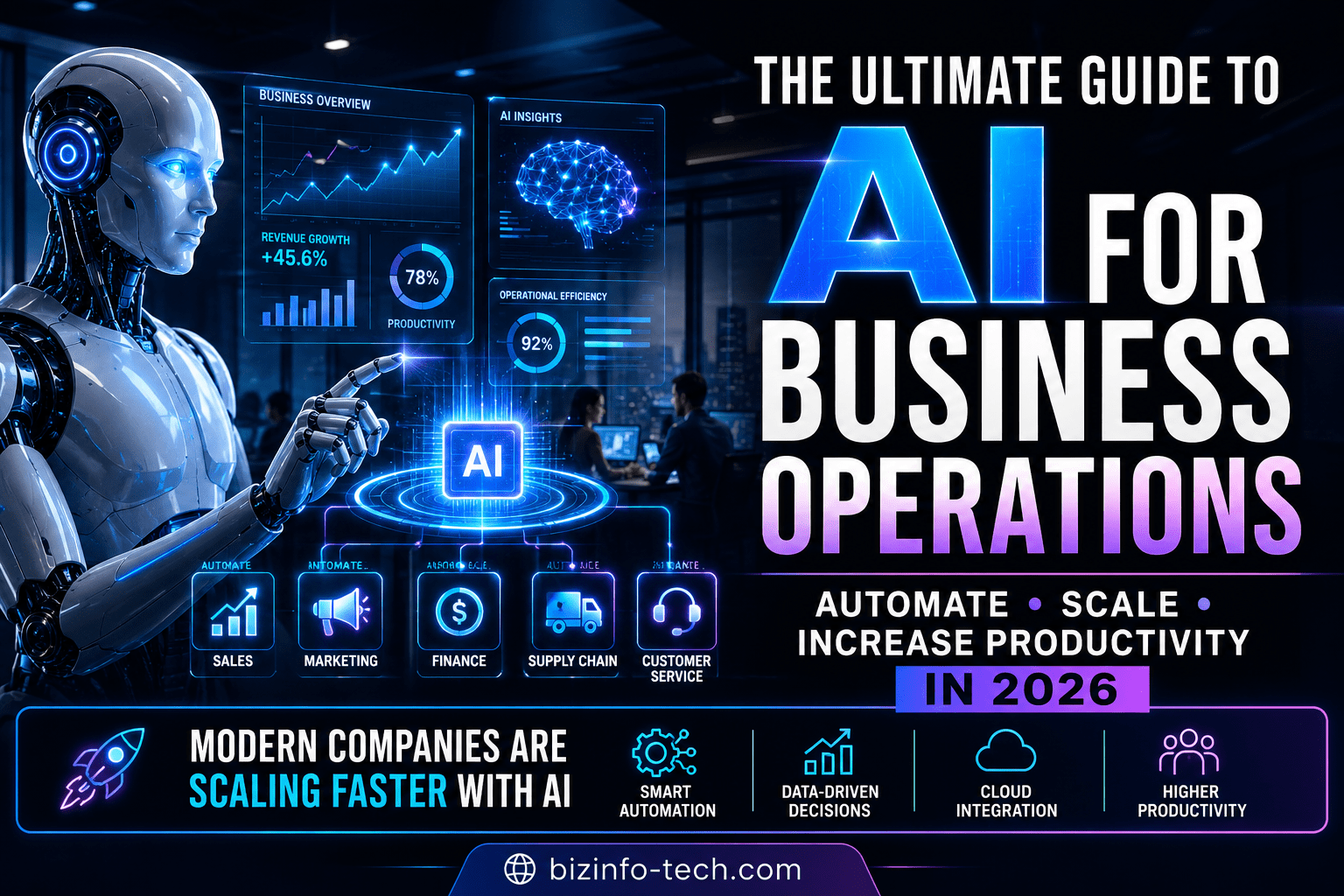
Introduction: Your Business Doesn’t Have a People Problem. It Has a Systems Problem.
Let me ask you something honest.
How much of your team’s day is spent doing work that actually moves the business forward — versus work that just keeps the lights on?
Updating spreadsheets. Answering the same emails. Copy-pasting data between tools. Scheduling meetings that could have been a message. Writing reports nobody reads.
If you’re like most business owners and operations managers, the uncomfortable truth is that a significant chunk of your most expensive resource — human time — is being spent on low-value, repetitive tasks that technology could handle in seconds.
This isn’t a people problem. Your team isn’t lazy or unproductive. The problem is the system they’re working inside.
Every day, across thousands of businesses, talented people are bogged down by inefficient processes, disconnected tools, and manual workflows that haven’t fundamentally changed in decades. The result? Teams stay perpetually busy, but the business struggles to scale. Costs creep up. Burnout sets in. Growth stalls.
Here’s what’s different about the companies pulling ahead in 2026: they’ve stopped trying to hire their way out of operational inefficiency. Instead, they’re building smarter systems — systems powered by artificial intelligence.
After studying modern business operations across industries, one pattern is impossible to ignore: organizations that successfully integrate AI into their daily workflows are creating more output with fewer resources, making faster decisions, and building a level of operational efficiency that would have been impossible five years ago.
This guide is going to show you exactly how they’re doing it — and how you can too.
Whether you’re a solo entrepreneur trying to do more with less, an operations manager looking to streamline your department, or a business owner ready to finally build the scalable company you’ve been picturing, this is the most practical, comprehensive guide to AI for business operations you’ll find anywhere.
Let’s get into it.
What Is AI for Business Operations?
Before we go any further, let’s make sure we’re talking about the same thing — because “AI for business” gets thrown around so loosely that it’s lost most of its meaning.
Defining AI Business Operations
AI for business operations isn’t about replacing your team with robots. It’s not about using ChatGPT to write a few emails and calling it a day. And it’s definitely not about spending six figures on enterprise software that takes two years to implement.
At its core, AI for business operations means using intelligent technology to handle the repetitive, rule-based, and data-heavy work inside your business — so your people can focus on the work that actually requires human judgment, creativity, and relationships.
Think of it this way: every business has two types of work. There’s the work that requires thinking — strategy, problem-solving, client relationships, creative decisions. And then there’s the work that requires doing — data entry, scheduling, reporting, routing, following up.
AI is exceptionally good at the doing. Humans are exceptionally good at the thinking. AI for business operations is simply about giving each the work it’s best suited for.
The Difference Between AI Tools, AI Workflows, and AI Systems
Here’s a distinction that matters a lot in practice, even though most people use these terms interchangeably.
AI Tools are individual software products that use AI to perform a specific function. Grammarly checks your writing. Notion AI summarizes your notes. A scheduling tool finds open calendar slots. These are useful, but they’re isolated.
AI Workflows connect multiple tools and automate a sequence of steps across them. Instead of manually moving a lead from your CRM to your email tool to your calendar, an AI workflow does it automatically when a trigger fires. This is where real time savings start to compound.
AI Systems are the full operational infrastructure — the combination of tools, workflows, automations, and decision-making logic that runs your business. When someone fills out your contact form, an AI system qualifies them, adds them to your CRM, assigns them to a rep, sends a personalized follow-up email, schedules a call, and notifies your team. Nobody touched it.
Most businesses are still using individual tools. The companies winning right now are building systems.
How AI Fits into Modern Business Infrastructure
Here’s the key mental model to take away from this section:
AI is not a tool. It is an operational layer that sits across your entire business.
Just like your internet connection isn’t one tool you use — it’s infrastructure that everything else runs on — AI is becoming the connective tissue of modern business operations. It sits between your systems, reads the data flowing through them, makes decisions, executes actions, and improves over time.
The businesses that understand this aren’t asking “which AI tool should I buy?” They’re asking “how do I build an operational layer that makes my entire business smarter?”
Why AI Has Become Essential for Modern Businesses
You might be thinking: we’ve gotten along fine without this stuff. Why is AI suddenly so essential?
Fair question. Here’s the honest answer.
The Rising Cost of Manual Processes
Manual processes have always had a cost. But for a long time, that cost was easy to ignore — a few extra hours here, a few mistakes there, a slightly slower turnaround than you’d like.
That calculus has changed.
Labor costs have risen significantly over the past several years. Customer expectations — for speed, personalization, and responsiveness — have shot up. And the volume of operational complexity inside even a small business has exploded, driven by more tools, more data, more channels, and more moving parts than ever before.
A process that was “good enough” five years ago is genuinely costing you money today. Not in an abstract sense — in real, measurable dollars and hours. The businesses that haven’t addressed this are quietly falling behind the ones that have.
The Productivity Gap Facing Small and Mid-Sized Companies
Here’s the problem that nobody talks about enough: small and mid-sized companies are competing in markets where the largest players have enormous operational advantages.
A Fortune 500 company can hire a team of 20 people to manage a single department. A small business doing similar revenue-generating work might have two or three people wearing six hats each.
For a long time, this gap was just a fact of life. You either raised funding to hire more people, or you hit a ceiling.
AI changes that equation. A small team with the right AI infrastructure can operate at the output level of a team twice or three times its size. Not by working longer hours — by building smarter systems.
After analyzing hundreds of business processes, one pattern consistently emerges: most companies are not limited by talent. They’re limited by inefficient systems.
Why Companies That Ignore AI Risk Falling Behind
This is the part that makes some business owners uncomfortable, but it needs to be said clearly.
The competitive advantage created by operational AI is not marginal — it’s compounding.
A business that automates 20 hours of weekly manual work doesn’t just save 20 hours. It frees up those hours for higher-leverage activities. It reduces errors. It speeds up response times. It creates data that improves decision-making. It allows the business to grow without proportionally growing headcount.
Meanwhile, a competitor doing the same work manually is paying more, moving slower, and making decisions with less information. Every quarter that gap widens.
This isn’t hype or fear-mongering. It’s just math. The businesses that build intelligent operations now are creating advantages that get harder to close over time.
The Five Core Areas AI Can Transform
AI can add value across virtually every function in a business, but there are five areas where the impact tends to be largest and most immediate. Let’s walk through each one.
1. Administrative Operations
Administration is the unglamorous backbone of every business — and it’s also the place where AI delivers some of its fastest wins.
Data Entry and Data Management
Manual data entry is one of the most common time sinks in small business operations. Customer information manually typed into CRMs. Invoice details transcribed from emails. Survey responses copied into spreadsheets. It’s repetitive, error-prone, and completely automatable.
AI tools can extract, structure, and sync data across your systems automatically — pulling information from emails, forms, documents, and external sources and routing it exactly where it needs to go.
Scheduling and Calendar Management
Scheduling meetings sounds trivial, but the back-and-forth involved in finding a time that works — across multiple people, time zones, and calendar systems — can burn through 30–60 minutes a day for a busy operations manager. AI scheduling tools eliminate that entirely by finding open slots, sending invites, and handling reschedules without human involvement.
Document Management
Finding, organizing, and version-controlling documents in a growing business is a surprisingly significant operational burden. AI-powered document management systems can automatically categorize files, surface relevant documents when you need them, and flag outdated versions — turning a messy shared drive into a functional knowledge base.
Internal Reporting
Most reporting is done manually: someone pulls data from multiple sources, drops it into a spreadsheet, formats it, and sends it out. This often takes hours that could be spent on analysis rather than compilation. AI can automate the entire data-gathering and formatting process, generating reports automatically on a schedule or on demand.
2. Sales Operations
Sales is one of the highest-leverage areas in any business, which makes it one of the best candidates for AI-assisted improvement.
Lead Qualification
Not all leads are equal — and having your sales team spend time chasing leads that will never convert is one of the most expensive inefficiencies in a business. AI can analyze lead data, engagement signals, and behavioral patterns to score and qualify leads automatically, so your team focuses their energy on the opportunities most likely to close.
CRM Updates
Sales reps hate updating the CRM. They also know they need to. The result is usually a CRM that’s perpetually out of date and unreliable for forecasting. AI tools that automatically log calls, update contact records, and track deal stages eliminate this friction entirely — and give leadership better visibility without more admin work from the team.
Follow-Up Automation
The fortune is in the follow-up — but consistent follow-up requires discipline that’s hard to maintain when your reps are juggling dozens of active deals. AI-powered follow-up sequences ensure that no lead falls through the cracks, automatically sending the right message at the right time based on where the prospect is in the process.
Sales Forecasting
Traditional sales forecasting relies heavily on gut feel and manager judgment. AI-powered forecasting uses real pipeline data, historical patterns, and deal-specific signals to generate more accurate projections — giving leadership the information they need to make better resource and capacity decisions.
3. Marketing Operations
Marketing is increasingly driven by data and personalization at scale — two things AI is exceptionally good at.
Content Creation
AI writing tools have matured significantly. They’re not replacing human creativity, but they’re accelerating it dramatically. First drafts, email subject lines, social media copy, product descriptions, ad variations — all of this can be drafted in minutes using AI, leaving your marketing team to focus on strategy, voice, and refinement rather than starting from a blank page.
Campaign Management
Managing multi-channel marketing campaigns — adjusting bids, rotating creative, segmenting audiences, analyzing performance — is a complex, data-intensive job that AI tools are increasingly taking over. Automated campaign management tools can optimize in real time based on performance signals that no human could track across hundreds of variables simultaneously.
Customer Segmentation
Treating your entire customer base the same way is one of the biggest missed opportunities in marketing. AI can analyze purchase history, behavior, demographics, and engagement patterns to segment your audience automatically — so you can deliver the right message to the right person at the right time.
Analytics and Reporting
Marketing generates more data than any team can realistically review manually. AI-powered analytics tools surface the insights that matter — flagging anomalies, identifying trends, and attributing revenue to specific campaigns — without requiring your team to spend hours building reports.
4. Customer Support Operations
Customer support is an area where AI has moved from novelty to genuine operational backbone for many businesses.
AI Chatbots
Modern AI chatbots are a long way from the frustrating, rigid bots of five years ago. Trained on your specific products, processes, and knowledge base, today’s AI chatbots can handle a surprisingly large percentage of common customer inquiries with accuracy and warmth — resolving issues instantly, 24/7, without a human in the loop.
Ticket Routing
When a customer support request comes in, getting it to the right person quickly matters. AI can analyze the content of incoming tickets and route them automatically to the appropriate team member based on topic, urgency, customer value, or any other criteria you define — eliminating the manual triage that slows down resolution times.
Knowledge Base Automation
Keeping your help documentation current is a constant challenge. AI tools can analyze your support tickets to identify common questions, suggest new articles, flag outdated content, and even draft documentation updates — keeping your self-service resources accurate and useful with minimal human effort.
Customer Success Workflows
Proactive customer success — checking in at the right moments, flagging accounts that show signs of churn, celebrating milestones — requires tracking far more data points than a human CS team can reasonably monitor. AI can watch all of that in the background and trigger the right action at the right time, making your team more effective without requiring more headcount.
5. Financial Operations
Finance is full of high-stakes, detail-intensive work that’s ideally suited for AI assistance.
Invoice Processing
Manually processing invoices — reading them, extracting line items, matching them to purchase orders, routing them for approval, and entering them into your accounting system — is time-consuming and error-prone. AI can automate most of this process, reducing the cycle time from days to hours and dramatically cutting the error rate.
Expense Tracking
Expense management is another area where manual processes create friction and inaccuracy. AI tools that automatically categorize transactions, flag policy violations, and generate reports give finance teams real-time visibility without requiring employees to spend time on tedious expense reports.
Forecasting
Financial forecasting has traditionally been a manual, spreadsheet-heavy process. AI tools that integrate with your financial data can generate rolling forecasts automatically, updating projections as conditions change and surfacing early warnings about cash flow issues or revenue shortfalls.
Budget Analysis
Analyzing budget performance manually — comparing actuals to plan, identifying variances, understanding the causes — is work that typically happens once a month when it should be happening continuously. AI-powered financial tools can surface this information in real time, so you can make adjustments before problems become serious.
Understanding the AI Operations Maturity Model
Not every business is starting from the same place. Before you can plot a path forward, it helps to understand where you are today.
Here’s a simple model for thinking about where your business sits on the AI operations spectrum.
Stage 1: Manual Operations
This is where most small businesses begin — and where many get stuck.
How it looks:
- Work happens primarily in spreadsheets and email
- Information lives in people’s heads and inboxes rather than systems
- Most processes require someone to manually perform each step
- Reporting is done by pulling data together manually, usually under pressure
The real costs:
- Growth is limited by how much work your team can physically handle
- High labor costs relative to output
- Significant error rates from manual data handling
- Poor visibility into what’s actually happening in the business
- Key-person dependencies that create fragility
If this sounds familiar, you’re not alone. And the good news is that the jump from Stage 1 to Stage 2 often delivers dramatic, fast improvements.
Stage 2: Automated Operations
At this stage, the business has started connecting its tools and automating the most repetitive manual work.
How it looks:
- Core workflows are automated (lead routing, invoicing, scheduling, reporting)
- Tools are integrated and talk to each other
- The team spends less time on data entry and more time on actual work
- Consistency is higher because processes don’t depend on individual memory
The benefits:
- Significant time savings — often 10–20+ hours per week at the team level
- Fewer errors from reduced manual handling
- Greater consistency in customer-facing processes
- Easier onboarding and knowledge transfer
This stage is achievable for virtually any business with relatively modest investment and effort. Tools like Zapier, Make, and HubSpot make it accessible without requiring a technical team.
Stage 3: AI-Augmented Operations
Here, the business has moved beyond basic automation into genuinely intelligent assistance.
How it looks:
- AI assistants are embedded in daily workflows — writing, analysis, communication
- Predictive insights inform decisions (forecasting, lead scoring, churn prediction)
- Decision support systems surface recommendations, not just data
- The team spends more time on high-judgment work and less on information processing
The benefits:
- Faster, better-informed decisions
- Higher individual and team productivity
- Better customer experiences through personalization and responsiveness
- Competitive advantage from capabilities that competitors without AI don’t have
Stage 4: AI-Powered Operations
This is the frontier — where the most forward-thinking businesses are operating today.
How it looks:
- Autonomous workflows run entire processes end-to-end with minimal human intervention
- AI agents handle complex, multi-step tasks independently
- Systems learn and improve over time
- Human oversight is focused on strategy and exception handling rather than execution
The benefits:
- True scalability — output grows without proportional headcount growth
- Compound operational advantage that widens over time
- The ability to operate with a leaner team at a higher output level
- Data-driven optimization that continuously improves business performance
Where most small to mid-sized businesses should focus today is the progression from Stage 1 or 2 toward Stage 3. Stage 4 is increasingly accessible, but Stage 3 alone delivers transformational results for most organizations.
The AI Operations Stack: Essential Technologies Every Business Needs
You don’t need dozens of tools. You need the right ones, working together. Here’s how to think about building your AI operations stack.
AI Productivity Tools
These are the tools that make individual knowledge workers more productive — AI writing assistants, meeting summarizers, research tools, and the general-purpose AI models (Claude, ChatGPT, Gemini) that your team can use for a wide range of tasks.
Think of these as the cognitive assistance layer of your stack. They don’t automate processes end-to-end, but they dramatically accelerate the work that requires human involvement.
Workflow Automation Platforms
Platforms like Zapier, Make (formerly Integromat), and n8n are the connective tissue of your operations stack. They allow you to build automated workflows that trigger on specific events, move data between your tools, and execute sequences of actions across your systems — without writing code.
If you’re not using at least one of these platforms in your business, this is the single highest-leverage place to start.
AI Writing and Communication Tools
Email drafting, content creation, social media, documentation, proposals, reports — a huge percentage of the knowledge work in most businesses involves writing. AI writing tools don’t replace human judgment, but they remove the friction of the blank page and compress the time required to produce quality written content.
Knowledge Management Systems
As businesses grow, knowledge becomes a serious operational challenge. Who knows how to handle X? Where’s the process for Y? What did we decide about Z?
AI-powered knowledge management tools (like Notion AI, Guru, or Confluence with AI integrations) help capture, organize, and surface institutional knowledge — so expertise isn’t trapped in individual heads and new team members can get up to speed faster.
Business Intelligence Platforms
Data is only valuable if someone can understand it and act on it. AI-powered BI tools (like Looker, Tableau, or lighter-weight options like Metabase) transform raw business data into visual dashboards and actionable insights — giving you and your team clear visibility into what’s working, what isn’t, and what needs attention.
How to Evaluate an AI Tool Before Adopting It
Before adding any new tool to your stack, run it through this simple framework:
Impact × Frequency × Time Saved
- Impact: How much does this process matter to the business?
- Frequency: How often does this process happen?
- Time Saved: How much time does this tool actually save per occurrence?
A tool that saves 30 minutes on a task that happens twice a year isn’t worth the overhead of adopting. A tool that saves 15 minutes on a task that happens 10 times a day is transformational.
Focus on high-impact, high-frequency processes first.
How to Identify Processes That Should Be Automated First
One of the most common mistakes businesses make is automating randomly — grabbing the coolest tool and hoping it helps. A better approach is systematic.
The Automation Opportunity Audit
Step 1: List Your Repetitive Tasks
Spend a week with your team capturing every task that someone does more than once. Don’t filter or judge — just list everything. Data entry, scheduling, reporting, follow-up emails, file organization, status updates, invoice generation, the works.
Step 2: Measure Time Consumption
For each task, estimate how much total time it consumes per week across your team. A task that takes 5 minutes but happens 50 times a week is consuming over 4 hours of weekly capacity.
Step 3: Identify Process Bottlenecks
Beyond time consumption, look for the processes that cause downstream delays or quality issues. A slow approval process might only take 10 minutes of actual work but create multi-day delays in your delivery workflow. Fixing that bottleneck creates compounding value.
Step 4: Prioritize High-Leverage Activities
Combine your time data with your impact assessment and rank your automation opportunities by leverage. Start with the tasks at the top of that list — the ones that consume the most time, create the most friction, or have the highest downstream impact.
The 80/20 Rule of Business Automation
Here’s a useful heuristic: in most businesses, about 20% of your manual processes are creating 80% of your operational friction.
Finding and fixing those processes — the ones that slow everything else down, cause the most errors, or consume disproportionate amounts of time — will deliver the majority of the value available in your operations.
The exercise to identify them is simple but powerful: for one week, every time you or a team member gets frustrated, slowed down, or stuck on a process, write it down. At the end of the week, you’ll have a clear map of your highest-leverage automation opportunities.
Building an AI-Powered Business: A Step-by-Step Framework
Knowing that AI can help is one thing. Building the actual systems is another. Here’s the practical framework — the same one used by the businesses that have made this transformation successfully.
Phase 1: Audit Current Operations
You can’t improve what you don’t understand. Before you add any AI or automation, map your current reality.
Mapping Existing Workflows
For each major function in your business — sales, marketing, operations, finance, customer support — document how work actually flows. Not how you think it flows or how the org chart says it should flow. How it actually moves through your team day to day.
This is often revealing. Gaps, redundancies, and inefficiencies that everyone has learned to work around become visible when you actually map the process.
Identifying Bottlenecks
As you map your workflows, pay particular attention to the handoffs — the moments where work moves from one person, team, or system to another. Bottlenecks almost always live at handoffs. They’re the points where work piles up, delays happen, and errors get introduced.
Phase 2: Standardize Processes
Here’s something that surprises most business owners: you cannot effectively automate a broken or undefined process.
AI requires structured inputs. If your process is different every time — if each team member handles a situation in their own way, with their own judgment and their own tools — there’s nothing consistent for AI to work with.
Why AI Requires Structured Inputs
Think about teaching someone to do a job. If the job is clearly defined — here are the steps, here are the decisions, here’s what good looks like — it’s trainable. If the job is “use your judgment and figure it out,” it’s much harder to replicate.
AI is the same. The more clearly defined and consistently executed your process is, the more effectively you can automate it.
Creating SOPs That AI Can Execute
A Standard Operating Procedure (SOP) is a documented, step-by-step description of how a process works. But not all SOPs are created equal. For AI to execute a process, your SOP needs to be specific about triggers (what starts the process), steps (exactly what happens in sequence), decision points (if X, then Y; if Z, then W), and outcomes (what does successful completion look like).
This is foundational work that pays dividends far beyond AI adoption — better SOPs make your whole business more consistent, trainable, and scalable.
Phase 3: Implement Automation
With clean, documented processes, you’re ready to start automating.
Connecting Systems
The first step is connecting your existing tools so information flows between them automatically. Your CRM should talk to your email platform. Your project management tool should update from your time-tracking software. Your invoicing system should receive triggers from your project completion workflow.
Start with the connections that reduce the most manual data transfer. These are usually the highest-value, lowest-complexity automations to build.
Reducing Manual Hand-Offs
Every time a human has to manually move information from one place to another, you have a candidate for automation. Look for these hand-offs systematically and build automations that eliminate them.
The goal at this phase isn’t perfection — it’s momentum. Get some quick wins, measure the time savings, and build confidence in the process.
Phase 4: Add AI Decision Support
Once your workflows are automated, you can layer AI intelligence on top.
Reporting
Instead of manually pulling reports, your systems can generate them automatically on a schedule — and instead of just presenting data, AI tools can surface insights, flag anomalies, and highlight what matters most.
Forecasting
AI-powered forecasting tools use your historical data to generate forward-looking projections — on revenue, pipeline, capacity, cash flow, and more. This gives you better visibility and allows you to make proactive decisions rather than reactive ones.
Strategic Recommendations
The most advanced AI tools don’t just report on what happened — they suggest what to do next. Which leads to prioritize. Which customers are at risk. Which campaigns to double down on. This is AI functioning as a genuine business intelligence layer, not just a reporting tool.
Phase 5: Create Autonomous Workflows
At the frontier of what’s possible today, AI agents can handle entire end-to-end processes without human involvement.
AI Agents
An AI agent is software that takes goals and figures out the steps to achieve them — browsing the web, using tools, sending communications, making decisions. The most advanced businesses are deploying AI agents for tasks like lead research, content creation, customer support triage, and competitive analysis.
Self-Updating Systems
Some AI systems can improve themselves over time — learning from the outcomes of their actions, identifying patterns in the data they process, and adjusting their behavior accordingly. While truly self-improving systems are still relatively advanced, the foundation for them is built in the earlier phases.
Human Oversight Models
Even in highly automated operations, humans remain essential for oversight, exception handling, and strategic direction. The goal isn’t to remove humans from the loop — it’s to elevate the work humans are doing to the level where human judgment genuinely matters.
Common Mistakes Companies Make When Implementing AI
The path to AI-powered operations is littered with expensive missteps. Here are the most common ones — and how to avoid them.
Automating Broken Processes
This is the single most common mistake: taking a process that doesn’t work well manually and automating it. The result is that bad outcomes happen faster.
Before you automate anything, make sure the underlying process is sound. Automation amplifies whatever it touches — both the good and the bad.
Buying Too Many Tools
There’s a phenomenon in the AI tools market that you might call “shiny object syndrome” — a new tool appears, it looks impressive in the demo, and before long you’ve got 20 subscriptions that only half your team uses.
The result is tool sprawl: more complexity, more cost, more training overhead, and — paradoxically — less productivity.
Start with fewer tools and use them more deeply. A business running four well-integrated tools will outperform one running twenty poorly connected ones every time.
Ignoring Employee Adoption
You can build the most sophisticated AI operations stack in your industry and still fail to capture most of the value if your team doesn’t actually use it.
Change management is not a nice-to-have. People change when they understand why the change matters, when they’re involved in designing it, and when they feel supported through the transition. Impose AI tools on your team without context or training, and you’ll get compliance at best and resistance at worst.
Failing to Measure ROI
If you can’t measure it, you can’t manage it — and you can’t justify it.
Before implementing any AI system, define the metrics you’ll use to evaluate success. Hours saved. Error rate reduction. Revenue impact. Customer satisfaction scores. Track these from day one and review them regularly.
This serves two purposes: it tells you whether your investments are working, and it builds the internal case for continued investment.
Treating AI as a Shortcut Instead of a System
The biggest mindset mistake is approaching AI as a quick fix rather than a long-term capability.
AI tools don’t deliver full value out of the box. They require setup, customization, integration, and iteration. The businesses that win with AI are the ones that commit to building it as a core operational capability — not the ones looking for a magic button to press.
Measuring the ROI of AI in Business Operations
How do you know if your AI investments are paying off? Here are the metrics that actually matter.
Key Metrics to Track
Hours Saved
The most direct measure: how many hours per week is your team saving because of AI and automation? Track this at the process level and aggregate it across your team.
Cost Reduction
Translate time savings into dollars. If automation saves your team 20 hours per week at an average fully-loaded labor cost of $50/hour, that’s $1,000 per week, or roughly $50,000 per year. Measure this against the cost of the tools and implementation time.
Process Speed
How much faster are key processes completing? Lead response time, invoice cycle time, customer support resolution time, onboarding duration — wherever speed matters, measure it.
Revenue Impact
Some AI improvements directly enable revenue growth — better lead qualification, faster follow-up, more personalized marketing. Where you can connect AI implementation to revenue outcomes, do so.
Employee Productivity
Are your team members able to accomplish more in the same time? Track output metrics — calls made, proposals sent, tickets resolved, content pieces published — alongside headcount to see if productivity per person is improving.
AI Leverage Formula
Here’s a simple formula for thinking about automation ROI:
(Time Saved × Frequency × Cost Per Hour) – (Tool Cost + Implementation Time)
Run this calculation before investing in any significant automation, and track actuals against your projections.
A positive number isn’t just about the math, though. There’s a qualitative impact that’s harder to measure: when your team isn’t grinding through repetitive work, they bring more energy and creativity to the work that matters. That’s real value, even if it doesn’t show up cleanly in a spreadsheet.
Real-World Examples of AI-Powered Business Operations
Let’s make this concrete with three examples of what AI-powered operations actually looks like in practice.
Small Business: Automating Administrative Tasks
A 12-person marketing agency was spending roughly 25 hours per week on administrative work: scheduling client calls, sending follow-up emails, updating project statuses, generating invoices, and compiling weekly reports.
They implemented a combination of AI scheduling tools, automated project management workflows, and an AI writing assistant for client communication templates.
The result: 18 hours of weekly admin time recovered. That’s nearly half an FTE — without any new hires. The team used those hours for client work, cutting their average project delivery time by 3 days.
Agency: AI-Powered Client Delivery Systems
A digital marketing agency was struggling to scale. Their work was high quality, but their delivery process was inconsistent — heavily dependent on individual team members, with no standard workflow.
They mapped their entire delivery process, built SOPs for every stage, and automated the handoffs between stages using a combination of project management tools and AI-assisted quality checks.
The result: delivery consistency improved dramatically, client satisfaction scores rose, and the agency was able to onboard new clients faster without proportionally increasing team hours.
Entrepreneur: Running a Lean Business with AI
A solo consultant was managing a six-figure business entirely on her own — which meant a constant balancing act between client work and the operational overhead of running a business.
She built an AI operations stack covering her entire business: automated lead qualification and follow-up, AI-assisted proposal generation, automated invoicing and payment follow-up, and an AI tool for drafting client reports.
The result: operational overhead dropped from roughly 20 hours per week to 5 hours per week. She redirected those 15 hours per week to client-facing work — and grew her revenue by 40% over the following year without changing her hours.
The Future of Business Operations Beyond 2026
We’re still in the early innings. Here’s where things are heading.
AI Agents as Digital Employees
The next evolution beyond AI tools and workflows is AI agents — autonomous systems that can take goals and figure out how to achieve them. Instead of automating a defined sequence of steps, agents can navigate ambiguity, use multiple tools, adapt to unexpected situations, and complete complex, multi-step tasks end-to-end.
Early AI agents are available today for specific functions — research, content creation, data analysis. Over the next few years, they’ll become capable enough to handle entire job functions semi-autonomously.
Autonomous Departments
The logical extension of autonomous workflows is autonomous departments — where entire business functions run largely on AI, with humans providing oversight, strategy, and exception handling rather than execution.
Finance departments that close the books automatically. Marketing departments where campaigns are planned, executed, and optimized by AI with minimal human input. Support departments where AI resolves the vast majority of customer issues.
This isn’t science fiction. It’s the direction the technology is clearly heading.
Predictive Operations Management
Today, most business intelligence tools tell you what happened. Tomorrow, AI systems will tell you what’s about to happen — and suggest what to do about it.
Predictive operations management means your systems are constantly modeling the future: forecasting demand, identifying risks, anticipating bottlenecks, and surfacing opportunities before they become obvious.
Human-AI Collaboration Models
The most important shift isn’t technological — it’s organizational. As AI takes over more of the execution layer of business, humans increasingly focus on judgment, creativity, relationships, and direction.
The businesses that win won’t be the ones with the most AI. They’ll be the ones that figure out the best ways to combine human intelligence and artificial intelligence — getting the best of both.
Frequently Asked Questions
What is AI Business Operations?
AI Business Operations refers to the use of artificial intelligence and automation technologies to manage, streamline, and optimize the core processes of running a business — from administrative functions and sales operations to customer support and financial management.
How can small businesses use AI?
Small businesses can start with accessible, affordable AI tools for specific functions: AI writing assistants, automated scheduling, workflow automation platforms like Zapier, and AI-powered CRM tools. The key is to start with your highest-friction processes and build from there.
What are the best AI tools for operations managers?
The right tools depend on your specific processes, but a strong operations stack typically includes a workflow automation platform (Zapier or Make), an AI assistant (Claude or ChatGPT), a project management tool with AI features, and an AI-powered CRM or sales tool.
Can AI replace administrative staff?
AI can handle many administrative tasks — scheduling, data entry, reporting, document management — but the best outcomes come from using AI to elevate administrative roles rather than eliminate them. With the right tools, an administrative professional can handle significantly more complexity, at higher quality, than they could manually.
How much does AI automation cost?
The entry point is lower than most people expect. Many powerful AI and automation tools start at $20–$50 per month. A full small business operations stack can often be built for $200–$500 per month — a fraction of the value it creates.
What processes should be automated first?
Start with the processes that are most repetitive, most time-consuming, and most clearly defined. Common early wins include scheduling automation, email follow-up sequences, data entry and CRM updates, and automated reporting.
Is AI safe for business operations?
Yes, with appropriate care. The key safeguards are: keeping humans in the loop for high-stakes decisions, protecting sensitive data through secure, reputable tools, and building audit trails so you can review what your automated systems are doing.
Conclusion: The Companies That Win Will Be the Ones That Build Better Systems
Here’s the bottom line.
Operational excellence has always been a competitive advantage. But for a long time, achieving it required resources that most small and mid-sized businesses simply didn’t have. The tools available today — and the AI capabilities layered on top of them — have changed that equation fundamentally.
The path to a truly efficient, scalable business has never been more accessible. You don’t need a large team, a massive budget, or a technical background. You need a clear understanding of your current processes, a systematic approach to improvement, and the willingness to build incrementally toward something better.
The businesses that thrive going forward will not necessarily be the ones with the largest teams or the biggest budgets. They will be the organizations that learn how to combine human expertise with intelligent systems to create operations that are scalable, efficient, and continuously improving.
Every competitive advantage in business eventually gets competed away. But the operational advantage created by AI compounds over time — because each improvement creates the foundation for the next one.
The time to start building is now.
Your first step: Pick one repetitive process in your business that you’ve been tolerating. Map it, clean it up, and automate it this week. Measure what happens. Then build from there.
The future of business operations isn’t about working harder. It’s about building systems that work smarter — so you and your team can do the same.



winbeatz online casino, winbeatz ponúka
širokú rukáv hier s casino hier po stolové hry.
Získejte pútavé zľavy a zažite nádherný zážitok!
winbeatz online casino,
winbeatz ponúka širokú rozsah hier zamerané na hráčov všetkých skúseností zručností.
Atraktívne bonusy a atraktívne akcie vytvárajú túto platformu
výnimočnou. Nechajte sa zlákať svojou preferovanou
hrou!
магазин парфюмерии, https://ladytag.ru/ – В нашем магазине
запахов представлен широкий каталог
эксклюзивных духов.
натуральная косметика, https://vgarderobe.ru/ становится все более популярной среди людей, стремящихся
к здоровью и красоте.
Добро пожаловать в известный
магазин парфюмерии, https://diet-menyu.ru/.
У нас огромный ассортимент душистых
композиций.
Парфюмерия оптом, https://slovarsbor.ru/ — это отличная возможность приобрести высококачественные ароматы по доступным ценам.
Парфюмерия, https://brain-toys.ru/
— это искусство создания уникальных эссенций, которые
способны передать наше внутреннее состояние.
магазин косметики, https://pcosmetik.ru/
предлагает широкий асортимент продукции для ухода за
кожей.